Hem jeans without losing the original hem (2 ways) so the worn fade still looks right
What You Need (tools, materials, time, skill level)
Keeping the original hem means you’re preserving the factory hem line: the wear, distressing, and that contrasting denim hem thread that makes jeans look “right.” It’s the #1 request I see in thrifting circles because a regular double-fold hem can look too new compared to the rest of the leg.
Tools & materials (from the source):
- Measuring tape
- Pins
- Seam ripper
- Hand needle
- Thread that matches the color of the jeans
- Thread that matches the original hem thread
- Serger (optional)
- Zipper foot (optional but helpful)
Time: Not stated in the source (depends on experience and equipment).
Skill level: Beginner-friendly, but you’ll be doing careful measuring and stitching close to an existing hem.
Beginner note: a zipper foot is a presser foot that lets you sew very close to bulky edges (like a hem ridge) because the needle can stitch right alongside the “bump.”
How To Do It
You’ve got two options here. Option 1 is the classic “original hem” fold method. Option 2 is a “binding hem” variation (the source lists it, but the steps shown are partial, so I’m only describing what’s actually provided).
Option 1: Keep the original hem (fold method)
This method makes a new seam just above the original hem, so the original hem stays visible on the outside.
1. Measure the excess length
- Put the jeans on (or measure carefully if you’re hemming without trying on) and fold up the amount you want to remove.
- Measure the folded-up amount (the “excess length”).
- The source’s preference: leave the actual hem out of this measurement, because jeans often shrink in length due to washing over time.
- Either way is acceptable; the source notes the hem itself is usually about 3/5 of an inch (1.5 cm), sometimes smaller, so it won’t make a huge difference for most hems.
2. Divide the excess by two
- You’re going to sew the excess as a fold, so you need half the amount.
- Example from the source:
- If you need to shorten 2 inches, half is 1 inch.
- If you need to shorten 5 cm, half is 2.5 cm.
- Remove your pin and re-fold the cuff to that half amount.
3. Pin on all four sides of each leg
- Pin the fold in place at all 4 sides of the leg.
- Why this matters: jeans legs twist easily at the seams. Pinning all around helps you match the side seams so the alteration is less visible.
4. Sew the seam close to the original hem (but don’t sew on it)
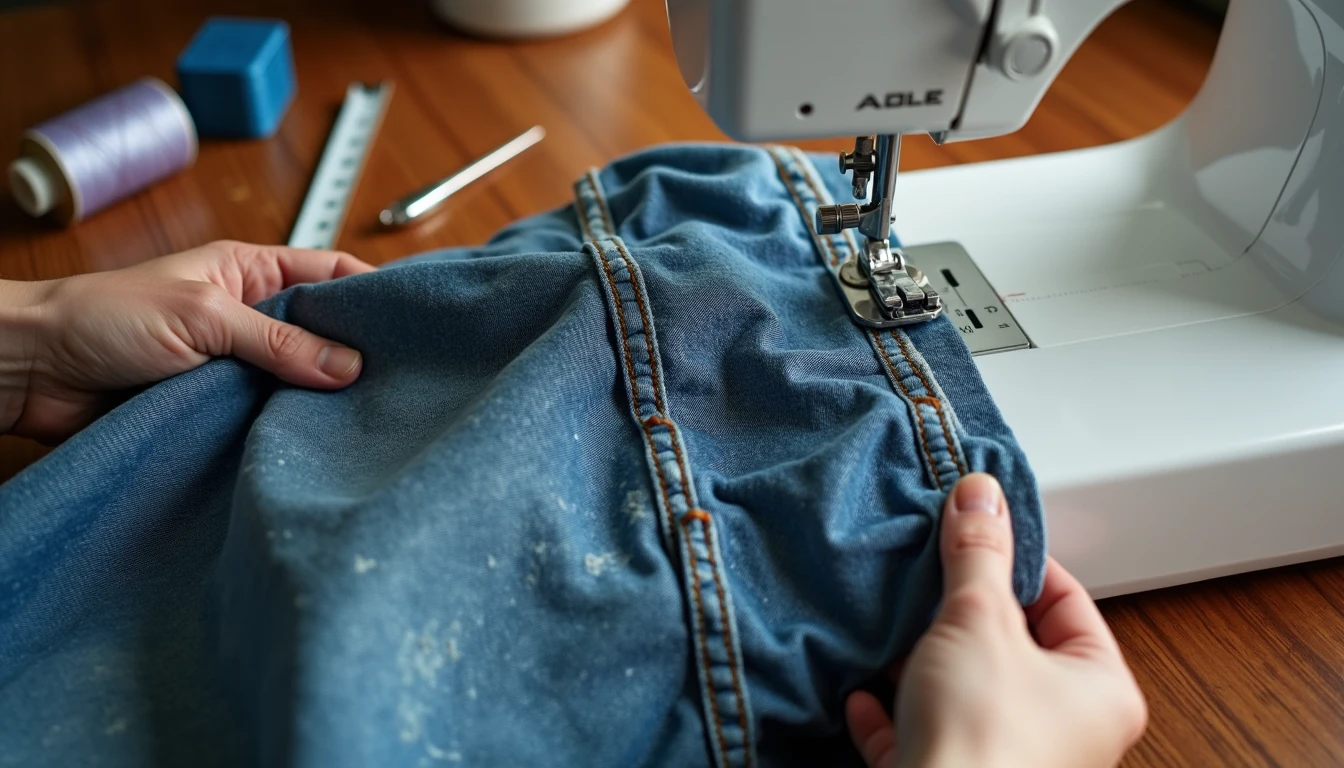
- Stitch as close as possible to the original hem, without stitching on the original hem line itself.
- The source prefers using a zipper foot and a matching blue thread.
- Check your work before continuing: look at the outside and confirm the side seams match and the hem looks even.
5. Remove (or finish) the excess fabric inside
- Once the seams are done, you can shorten the excess on the inside.
- The source likes to do this with a serger.
- You can also skip this step if:
- The excess inside isn’t much, or
- You have doubts about the final length and want to keep fabric until you’re sure.
6. Fix the fold in place
- To keep the fold from flipping around during wear/wash, the source hand-sews a couple of stitches at the side seams, placed so they’re not visible on the outside.
- Sometimes, if you have a really good matching blue thread, the source chooses to topstitch on the face side instead of hand-tacking.
That’s it: from the outside, you still see the original hem—with its fading and distressing—so the jeans don’t look “freshly altered.”
Option 2: Keep the original hem with a binding hem (as provided)
The source lists a second method called a binding hem, and shows the required tools and the first measuring steps.
Tools (from the source):
- Measuring tape
- Seam ripper
- Pins
- Thread that matches the original hem thread
- Thread that matches the color of the jeans
Steps shown in the source:
1. Measure the excess length (same reasoning: jeans can shrink in length due to washing over time; hem is often about 3/5 of an inch (1.5 cm)).
2. Example measurement given: shorten by 2 inches (5 cm).
3. Divide the excess by two (so 1 inch or 2.5 cm).
Because the source content provided cuts off mid-instructions for option 2, I’m not going to invent the missing construction steps. If you want, paste the remaining option 2 text and I’ll rewrite it in the same beginner-friendly, real-process style.
Where It Goes Wrong (and how to recover)
These are the beginner failure modes I see constantly in our Stitch & Swap Talk chats—no shame, I’ve done them too.
- Twisted side seams
- Sign: The outseam/inseam doesn’t line up where the fold is pinned, and the hem looks rotated.
- Fix: Go back to the step where you pin on all four sides. Re-pin with extra attention to matching the side seams before sewing.
- You accidentally stitch on the original hem
- Sign: You can see a messy “double line” right on the original hem ridge.
- Fix: Use the seam ripper to remove just that section and re-stitch as close as possible without sewing on it, ideally with a zipper foot for control.
- The new seam is too far from the original hem
- Sign: From the outside, you see a noticeable band above the hem that looks like a DIY ridge.
- Fix: Re-stitch closer to the original hem line (again, zipper foot helps). Check from the outside before trimming any excess.
- You trimmed the inside too early
- Sign: You’re not sure about the final length, but the excess is already cut.
- Prevention: Follow the source’s advice: if you have doubts, skip trimming until you’re confident.
- The fold flips up during wear
- Sign: Inside fold doesn’t stay flat after washing or walking.
- Fix: Add a couple of hand stitches at the side seams (tiny tacks placed so they don’t show outside), exactly like the source recommends.
Pro Tips (practical, not precious)
- Treat “measure, divide by two, re-fold” as the core math. This is the step people rush, and it’s the whole trick of the original-hem fold method.
- Check from the outside before you commit. The source explicitly checks side seams and appearance before moving on—do that. It saves you from unpicking later.
- If you don’t have a serger, don’t panic. The source says you can “clean the edges as you prefer” or skip it when the inside excess isn’t much or you’re uncertain. The key is: don’t trim until you’re sure.
- Hand tacks are your quiet hero. A couple of stitches at the side seams keep everything behaving, and you don’t have to fight bulky topstitching if you’re new.
Bottom Line (when to DIY vs. outsource)
If you love the worn-in fade and distressed hem on your thrifted jeans, keeping the original hem is the difference between “looks factory” and “looks obviously shortened.” Option 1 is fully doable for beginners with careful pinning and patient stitching close to the original hem.
If you’re unsure about option 2 (binding hem), don’t force it from incomplete instructions—either track down the full steps or stick to option 1, which is clearly laid out. And if your side seams keep twisting no matter what, that’s a reasonable moment to hand it to a tailor—because the whole goal here is an alteration that disappears.