
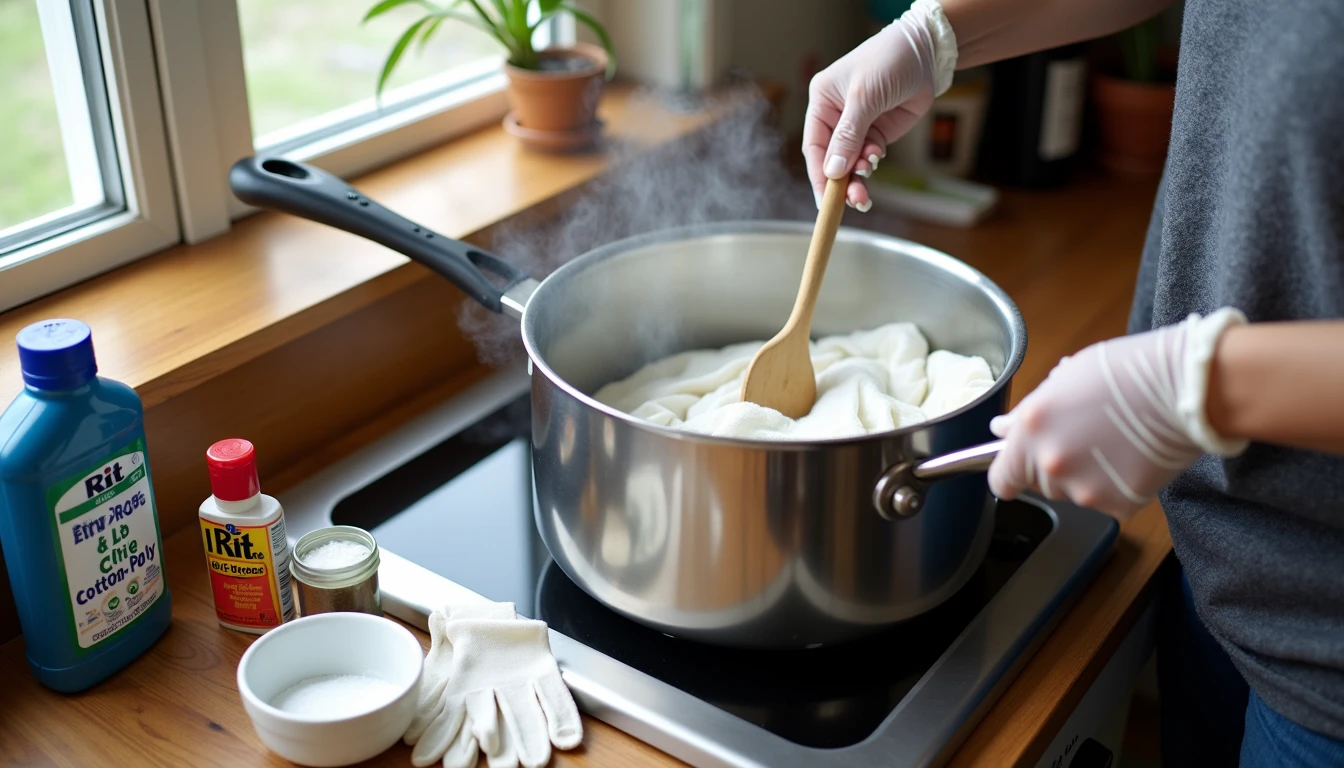
Dyeing cotton-poly blends at home: the dual-dye method for better color (and fewer surprises)
What You Need (tools, materials, time, skill level)
Payoff: You *can* dye cotton-polyester blends, but the win is learning how to control the “heathered” (slightly mixed/uneven) look instead of fighting it.
Why blends are tricky: Cotton drinks up dye, polyester mostly shrugs it off unless you use a dye made for synthetics. So your color often lands lighter and more tonal than you pictured.
Materials (from the source):
- Rit All-Purpose (dyes the cotton portion)
- Rit Dyemore (dyes polyester; essential for blends)
- Large stainless pot (for stovetop dyeing; the source warns not to use food pots after)
- Gloves (dye stains hands fast)
- Salt (fixative for cotton)
- White vinegar (helps polyester bond with dye)
Time: The source’s steps add up to about 30 minutes for the cotton dye bath plus 30–60 minutes for the polyester dye bath, *plus* rinsing time.
Skill level: Beginner-friendly, but you need patience and you need to stir.
What to expect: Not solid, factory-flat color. More like a soft, blended, “lived-in thrift find” tone. Honestly, in my Toronto upcycling circle, that’s usually the vibe we’re chasing anyway.
How To Do It
First: decide which method fits your blend
- If you’re dyeing a 65/35 cotton/poly blend: Use the Dual-Dye Technique (two separate dye baths).
- If you’re dyeing a 50/50 blend or anything with 50%+ polyester: Use the Single-Dye Shortcut with Rit Dyemore only (the source notes it can partially tint cotton too).
Method 1: Dual-Dye Technique (for 65/35 blends)
This is the “more steps, fewer regrets” route.
1. Pre-wash the fabric
- The source is specific: remove dirt/oils and use no fabric softener.
- Why it matters: anything on the fabric can block dye and cause blotches. (My first attempt years ago came out patchy because I treated pre-washing like “optional.” It’s not.)
2. Make the cotton dye bath (Rit All-Purpose)
- Fill the pot with hot water: 140°F / 60°C
- Add 1 bottle Rit All-Purpose and 1 cup salt
- Put in the fabric and soak 30 minutes, stirring
- Why stir: dye settles and fabric folds hide from the dye, creating light streaks.
3. Rinse
- Rinse with cold water
- This is your reset before the polyester step.
4. Make the polyester dye bath (Rit Dyemore)
- Same pot, but fresh water
- Add 1 bottle Rit Dyemore and 1 cup vinegar
- Simmer 30–60 minutes (the source says longer equals darker polyester)
- Why this step is separate: the source warns not to mix All-Purpose and Dyemore together because they require different temperatures.
5. Rinse and dry
- Rinse until water runs clear
- Air-dry
- If the color looks a bit dull while wet, don’t panic. Wet fabric lies.
Method 2: Single-Dye Shortcut (for 50/50+ polyester)
This is for blends where polyester is a big player.
1. Skip Rit All-Purpose
- Use only Rit Dyemore (per the source).
2. Simmer in Dyemore + vinegar
- Simmer fabric in Dyemore + vinegar for 60+ minutes
- Expect: a muted, tonal effect where cotton tints lighter than polyester.
Where It Goes Wrong (and how to recover)
- Mistake: expecting a vibrant solid
- Sign: It looks heathered or lighter than the bottle color.
- Fix: Reframe it as the “blend effect.” The source says to *embrace the heathered look*. If you want a more intentional finish, use tie-dye or dip-dye (see tips below).
- Mistake: trying to dye in a washing machine
- Sign: Weak color, uneven take-up.
- Why: The source says blends need sustained heat, which a typical wash cycle won’t hold the way a stovetop simmer will.
- Fix: Stovetop method only for this project.
- Mistake: mixing Rit All-Purpose and Rit Dyemore together
- Sign: Unpredictable results and wasted dye.
- Fix: Keep them as separate baths as the source instructs.
- Mistake: skipping pre-wash or using fabric softener
- Sign: Splotches or areas that won’t take dye.
- Fix: Re-wash (no softener), then re-dye. It’s annoying, but it’s the cleanest recovery.
- Mistake: not stirring
- Sign: fold lines or “shadow” streaks.
- Fix: Keep the fabric moving. Set a timer if you need to so you remember to stir consistently.
Pro Tips (from the community + what the source supports)
- For darker colors, increase Dyemore
- The source tip is clear: double the Dyemore dose for deeper color.
- Hide imperfections on purpose
- The source calls out tie-dye or dip-dye as ways to mask unevenness. If you’re nervous, these styles are beginner-forgiving because variation looks intentional.
- Test first
- The source suggests dyeing a hidden seam to preview color. This saves you from the “why is it not the shade in my head” moment.
- If your blend is 50%+ polyester, simplify
- The source’s pro tip: use only Rit Dyemore for high-poly blends because it partially tints cotton too.
Bottom Line (when it’s worth it)
Dyeing a cotton-polyester blend is absolutely doable if you accept the trade-off: character over perfect uniformity. Use the dual-dye technique when you want the most balanced result on a 65/35 blend, and use the Dyemore-only shortcut for 50/50 or higher polyester where the polyester needs the heavy lifting.
Take it to a tailor/dry cleaner instead if you can’t do stovetop simmering safely or you can’t dedicate the attention to stirring and temperature control. Blends are not a “set it and forget it” dye job.